
How to Choose a Crawler Boom Lift: A Practical Buyer’s Guide
Choosing a crawler boom lift is not simply a matter of selecting the tallest machine in a catalogue. The right decision connects the work at height with the ground below, the route into the site, the space available for setup, the load in the platform, the power supply, and the way the machine will be transported and supported after delivery. A model that reaches the roof but cannot pass through the gate is not a workable solution. A compact machine that enters easily but cannot provide the required outreach may create an equally serious problem.
This guide explains how contractors, rental companies, facility managers, distributors and procurement teams can define those requirements before asking for a quotation. It also shows how to compare the ZMT CBL12–CBL32 range without treating a model name as a complete specification. The purpose is not to choose a machine from one number. It is to create a short, verifiable requirement sheet that a supplier can match to the correct configuration.
The first principle is simple: select for the real task, not for an impressive headline figure. Working height matters, but so do horizontal reach, platform capacity, access dimensions, outrigger footprint, ground conditions, operating limits, power configuration and local compliance. When these variables are considered together, the buying process becomes faster and the risk of an unsuitable machine becomes much lower.
1. Start with the work, not the model number
Before comparing machines, describe the work in operational terms. What must the operator reach? Is the task directly above the machine, behind an obstacle, beneath a roof edge, inside a courtyard or across landscaped ground? How many people, tools and materials will be in the platform? Will the lift complete one stationary task or move repeatedly between work zones?
A useful job description should include the work location, target elevation, nearest safe setup area, obstacles, expected ground condition and duration of use. Photographs, a simple site drawing and basic measurements can be more valuable than a general request for a “20 metre lift.” They allow the supplier to see whether articulated reach, telescopic outreach, compact access or a particular power option is the dominant requirement.
For recurring fleet use, define the range of jobs the machine must cover rather than one perfect project. A rental company may value transport efficiency and broad utilization. A tree-care contractor may prioritize tracked mobility, obstacle clearance and controlled positioning. A facility team may place more weight on low-noise power and access through restricted areas. The best model is the one that solves the highest-value group of tasks with acceptable transport, setup and ownership costs.
2. Separate platform height, working height and horizontal outreach
Height terminology causes many purchasing mistakes. Platform height normally describes the maximum height of the platform floor. Working height is commonly estimated above that level to represent an operator’s reach, but the convention and published value can vary. A model number may refer to platform height, working height or a series designation. Never assume that the number in the name answers the complete height question.
Ask for the final technical sheet and verify three separate values: maximum platform height, maximum working height and maximum horizontal outreach. Then compare them with the actual work point. If the target is 16 metres above ground but set several metres behind a façade, vertical height alone does not prove that the platform can reach it. The correct check uses the model’s working envelope or load chart.
Outreach is especially important for façade work, tree maintenance, roof-edge access and sites where the machine cannot be positioned directly beneath the task. Basket load, boom angle and configuration may affect the permitted working envelope. The requested operating point should therefore be checked at the intended platform load, not against one maximum outreach number viewed in isolation.
Add a sensible project margin, but avoid buying excessive height without a reason. A larger machine can require more transport capacity, a wider or longer setup area and a higher capital budget. The goal is adequate reach throughout the planned work zone, not the largest specification available.
3. Calculate the real platform load
Platform capacity must cover more than the operator’s body weight. Include every person, tool, cable, consumable, attachment and material expected in the basket. If two workers carry glazing tools, cleaning equipment or pruning equipment, the total can increase quickly. The calculation should be written down and compared with the rated capacity and the applicable working envelope.
Do not treat platform capacity as a target to use continuously without management. Allow for realistic variation in operator weight and tools. Establish a site rule that materials cannot be added casually after setup. If the work requires lifting heavy components, remember that an aerial work platform is designed to position personnel and permitted tools; it is not automatically a substitute for a crane or material hoist.
ZMT’s current crawler boom lift pages commonly list a 200 kg rated load, but the final value, basket arrangement and operating envelope should be confirmed for the exact model and configuration on the quotation. Buyers should also ask whether any optional platform function or accessory changes the capacity or machine geometry.
4. Evaluate the ground before relying on the tracks
Tracks can improve mobility and distribute contact compared with some wheeled arrangements, but “crawler” does not mean the machine can travel or operate safely on every soft, sloped or uneven surface. Ground bearing capacity, hidden voids, drainage channels, recent excavation, basement slabs, paving, turf protection and surface contamination all matter.
Separate travel conditions from operating conditions. A machine may be able to travel across an appropriate slope or rough area within its stated limits, yet still require a prepared, stable and correctly levelled setup zone before elevating the boom. Confirm both the maximum travel slope and the permitted operating inclination from the manual. Do not use gradeability or a promotional rough-terrain description as permission to elevate on an unsuitable slope.
Outrigger loads are concentrated at the contact points. The site assessment should determine whether mats, pads or additional engineering checks are required. Larger pads can help spread load, but they do not repair weak ground. The competent person responsible for setup must consider soil, slabs, underground services, edges, trenches and changing conditions after rain.
For sensitive landscaping, tracks may reduce localized damage during travel, but turning can still scuff turf and outriggers still impose point loads. Plan the route, minimize sharp turns and agree protective measures before the machine arrives. A photograph of the track does not replace ground-pressure and outrigger-load information from the supplier.
5. Measure the entire access route and setup footprint
The narrowest gate is only one part of access planning. Measure width, height, turning space, surface transitions, ramps, door thresholds and overhead obstructions along the entire route from unloading point to setup position. Check whether the platform can be removed or repositioned for transport only if the manufacturer explicitly supports that procedure.
Record the machine’s stowed length, width and height, total weight and any adjustable track-width arrangement. Confirm the dimensions for the quoted configuration rather than a generic catalogue image. A change in engine, battery, basket or optional equipment can affect weight or packaging.
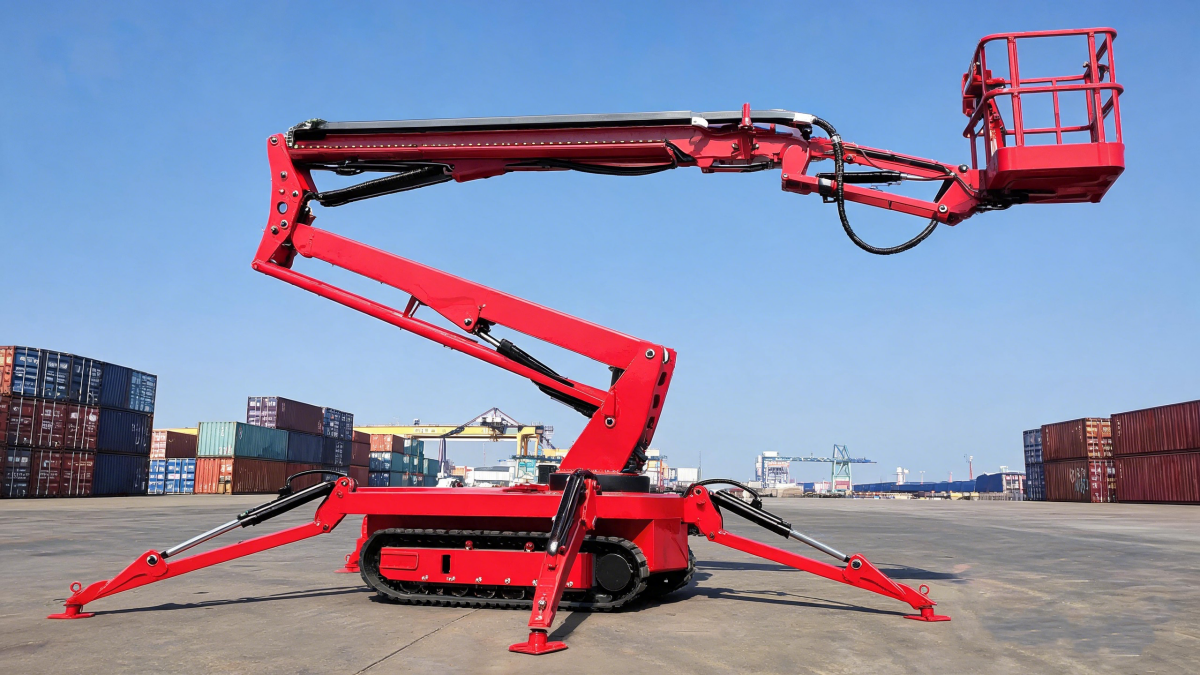
Setup dimensions are different from travel dimensions. Outriggers can extend far beyond the tracked chassis, and the boom needs clearance to rotate through the planned work zone. Ask for an outrigger footprint drawing and the tail-swing or rotation envelope. On narrow streets, courtyards and busy facilities, also reserve space for barriers and pedestrian exclusion—not merely the steel footprint of the machine.
If the machine will be used indoors or on a suspended slab, verify floor loading, point loads, doorway clearances, ventilation and marking risk from tracks. If it must enter a lift or loading platform, obtain the equipment’s rated capacity and internal dimensions. Access should be proven with measured numbers, not visual estimates.
6. Match the power source to the environment and duty cycle
Power configuration affects noise, emissions, runtime, refuelling, charging, maintenance and regional suitability. ZMT states that selected crawler boom lifts may be available with DC battery, diesel, gasoline, external electric or dual-power arrangements, depending on the model and destination market. Availability must be confirmed on the quotation.
Battery power can suit indoor work, low-noise areas and projects where local exhaust emissions are undesirable. The buyer should verify battery type, voltage, capacity, charger input, expected duty cycle, charging time and storage requirements. “A full shift” is not a universal runtime specification because boom movements, travel, temperature, battery condition and operator behaviour change energy use.
Combustion power may fit longer outdoor duty cycles or remote locations, but the buyer must verify the engine make and model, fuel, service parts, emissions requirements and local regulations. Never operate a combustion engine in an enclosed space without a compliant risk assessment and ventilation controls.
Dual-power can improve flexibility when a machine moves between outdoor travel and indoor work, but it adds configuration questions. Ask which functions each source can power, whether charging occurs during engine operation, and what maintenance applies to both systems. For imported equipment, confirm plug type, AC frequency, charger voltage and documentation language before production.
7. Understand boom geometry, rotation and platform positioning
Two machines with similar working heights can behave differently around obstacles. Articulated sections help lift the platform up and over obstructions. Telescopic sections add direct outreach. A jib or rotating platform, where offered, can improve final positioning. The selection should be based on the shape of the work envelope, not simply on height.
Ask for the working-envelope diagram and identify several representative points: the highest task, the furthest task, a task over an obstacle and the lowest outreach point. Mark the expected basket load at each point. If the supplier cannot confirm a critical point from the load chart, the model should not be selected on assumption.
Rotation terminology also needs care. The product pages may describe 359-degree discontinuous rotation on some models and continuous rotation on selected configurations or options. Confirm the actual turntable arrangement, any stop point, hose-management system and platform rotation for the quoted machine. In restricted spaces, the position of the boom, basket and chassis during rotation can matter as much as the headline angle.
Smooth controls, upper and lower operating stations, emergency lowering and platform levelling are important operating features. Buyers should request an operating demonstration or video for the proposed configuration and include operator familiarization in the delivery plan.
8. Verify safety functions and documentation
Safety cannot be reduced to a list of attractive feature names. The machine, manual, labels, inspection procedures and operator training must form one usable system. Ask the supplier to identify the emergency stop, emergency descent, overload protection, tilt or inclination warning, interlocks, platform levelling arrangement and ground-control functions fitted to the exact configuration.
Request the operation and maintenance manual before shipment if possible. Confirm the language, inspection intervals, lubrication schedule, hydraulic-fluid specification, electrical diagrams, spare-parts list and troubleshooting information. For the destination market, determine which conformity documents, test records, labels and local inspections are required. Requirements differ by country and application, so a general statement about certification is not enough.
Operators must be trained and authorized under the rules that apply at the site. They also need model-specific familiarization covering controls, emergency procedures, setup and limitations. A harness or restraint requirement should follow the manufacturer’s instructions, platform design and local rules. The buyer should not write a generic fall-protection rule without checking those sources.
9. Use a model range as a shortlist, not a final answer
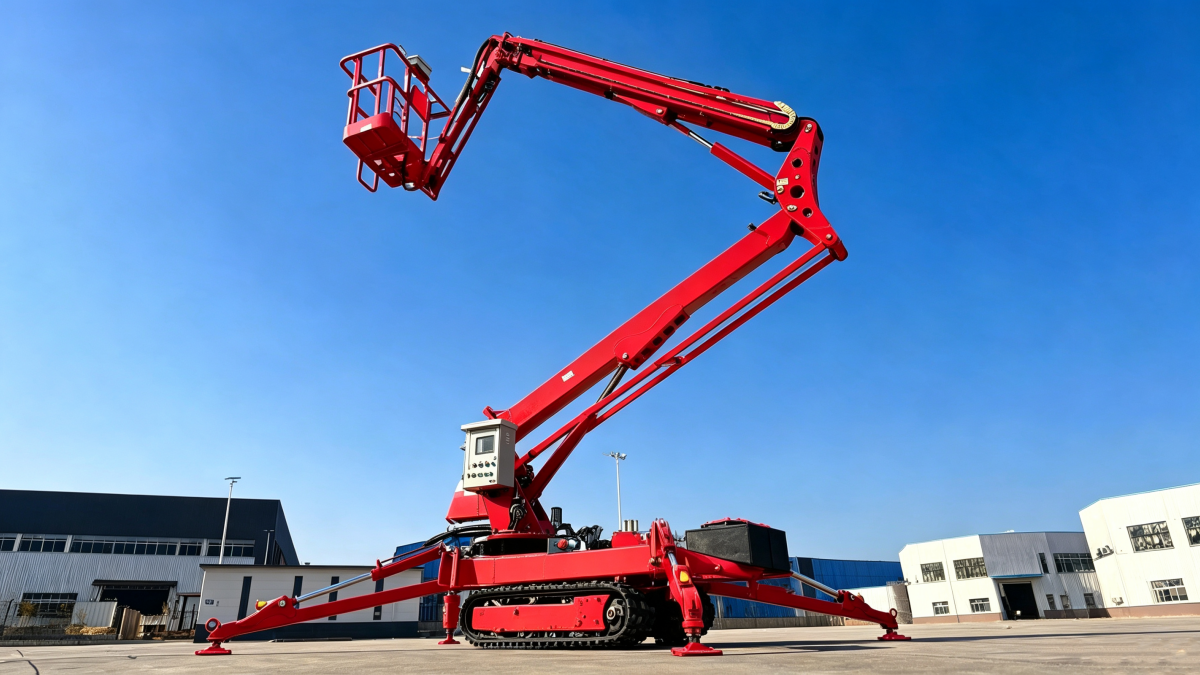
ZMT’s crawler category currently includes CBL12, CBL14, CBL16, CBL18, CBL20, CBL22 and CBL32 models. The category positions CBL12–CBL16 as more compact-height choices and CBL18–CBL22 as mid- to higher-reach options, with CBL32 intended for substantially greater vertical access. This is a useful first-stage shortlist.
For a compact access or routine maintenance project, begin by comparing CBL12, CBL14 and CBL16. For façade, utility, tree-care and larger construction access, evaluate the CBL18–CBL22 group. When the project genuinely requires high reach, assess CBL32 along with transport, setup and outreach constraints. These ranges are not application approvals; they are prompts for a more detailed comparison.
Current product pages contain some inconsistent fields—for example, certain “maximum platform height” rows display a model code instead of a dimension. Buyers should therefore request the current signed specification sheet and working envelope for the exact serialised configuration. ZMT should correct the web fields, but procurement should still rely on the controlled quotation and technical documents.
10. Compare transport and total ownership cost
Purchase price is only one cost. Add inland collection, export packing, ocean or road freight, insurance, customs, local delivery, unloading, commissioning, inspection, training, routine service, batteries or engine parts, hydraulic components and downtime risk. A heavier or longer model may require a different trailer, container plan or transport permit.
Ask for shipping dimensions and weight in the exact export condition. Confirm whether the platform, tracks or other components are removed, how the machine is secured and what assembly is required on arrival. If a distributor will stock several units, compare container utilization and workshop handling as part of the model decision.
Support quality affects lifetime cost. Request recommended spare parts for the first service period, consumable part numbers, warranty terms, response channels and remote diagnostic capability. A lower initial price can be expensive if a small unavailable component stops the machine during a project.
11. Prepare a quotation request that produces a useful answer
A vague enquiry creates a vague quotation. Send the supplier a structured requirement with the target working points, platform load, site conditions, access constraints and destination details. The supplier can then confirm a model or explain which requirement drives a different choice.
Include the following information:
- Required platform height and working height, clearly labelled.
- Required horizontal outreach at the expected basket load.
- Number of operators plus the total weight of tools and materials.
- Ground type, slope, slab or soil information, and expected weather exposure.
- Narrowest access width and height, turning restrictions and setup area.
- Preferred power source, fuel, charger voltage and local AC frequency.
- Destination country, delivery address or port, quantity and target date.
- Required documents, language, conformity and inspection expectations.
- Transport limits and available unloading equipment.
- Photographs, drawings and a marked location for the proposed setup.
Then ask the supplier to return a final specification, working envelope, outrigger footprint, shipping data, included accessories, optional equipment, warranty, lead time and quotation validity. This turns the conversation from “What is your price?” into a technical match that procurement can evaluate.

12. Common selection mistakes to avoid
The first mistake is choosing only by maximum height. The work may require more outreach, a different boom geometry or a smaller transport envelope. The second is assuming tracks permit operation on any rough ground. Mobility does not remove the need for bearing-capacity checks, levelling and outrigger support.
The third mistake is reading one web table as the final contract specification. Product pages are useful for discovery, but model fields, options and destination configurations can change. The controlled quotation and technical sheet should resolve every important number. The fourth is ignoring the route between the delivery truck and the work area. Access failures often occur at gates, turns, ramps and surface transitions rather than at the final setup point.
The fifth is choosing power without analysing the duty cycle and infrastructure. A battery machine needs a workable charging plan; a combustion machine needs suitable fuel, service access and ventilation controls. The sixth is failing to budget for training, inspection, spare parts and local compliance. These are part of putting the lift into productive service, not optional administrative extras.
Frequently asked questions
What is the main advantage of a crawler boom lift?
The tracked chassis can improve mobility and contact on appropriate uneven, landscaped or rough surfaces, while an articulated or telescopic boom provides elevated access around obstacles. The benefit is site-specific. Ground capacity, slope, access and setup requirements must still be verified.
Should I choose by platform height or working height?
Use both, but define them clearly. Platform height describes the platform floor elevation; working height is an estimated operator reach convention. Also verify horizontal outreach and the working envelope at the expected platform load.
How much outreach do I need?
Measure the horizontal distance from the nearest safe setup position to the furthest work point, including obstacles. Add only a reasonable planning margin, then confirm that point on the manufacturer’s working-envelope diagram at the intended basket load.
Can crawler boom lifts work on slopes?
They can travel or set up only within model-specific limits and on ground capable of supporting the machine. Travel-slope capability is not the same as permitted operating inclination. Check the manual, use the levelling system as instructed and complete a site assessment.
Which power source is best?
Battery can suit low-noise or indoor work; combustion power can suit longer outdoor operation; dual-power may serve mixed environments. The correct choice depends on runtime, charging, fuel, ventilation, temperature, service parts and local rules.
What dimensions should I request before ordering?
Request stowed length, width and height; total and shipping weight; track dimensions; basket dimensions; outrigger footprint; tail-swing envelope; ground clearance; and any dimensions after transport preparation. Confirm values for the quoted configuration.
What should be confirmed before paying a deposit?
Confirm the model and configuration, working envelope, rated load, power system, transport data, included and optional equipment, documentation, applicable conformity, warranty, lead time, payment terms and after-sales contact. Put these items in the order documents.
Make the final choice with project data
The most reliable crawler boom lift selection begins with a measured work point and ends with a confirmed technical package. Define the required height, outreach, load, access, ground, setup, power and transport conditions. Use the CBL model range to create a shortlist, then ask ZMT to confirm the exact configuration against the working envelope and destination requirements.
For a project-specific recommendation, send ZMT your site photographs, measurements, basket load, preferred power source, destination country and delivery timeline. The result should be more than a price: it should be a machine configuration that can enter the site, set up correctly, reach the planned work and be supported throughout its service life.
When your job site has slopes, rough terrain, or sensitive floors — a wheeled boom lift is the wrong tool. Full stop.