
Towable Boom Lift Working Height: How to Choose the Right Reach
When buyers request a towable boom lift, the first question is usually, "How high can it go?" It is an important question, but it is not enough to select the correct machine.
A platform can have sufficient vertical height and still fail to reach the work. The obstacle may be too wide. The setup point may be farther from the building than expected. A roof edge may block the platform. The basket capacity may be reduced in part of the working envelope. The outriggers may not fit in the available space.
Correct selection therefore requires more than comparing model names such as 12 m, 14 m, 16 m or 18 m. The buyer must understand platform height, stated working height, horizontal outreach, up-and-over clearance, platform capacity, support footprint and access conditions.
This guide explains how to evaluate towable boom lift working height without overbuying, under-specifying or relying on an ambiguous brochure number.
Platform Height vs Working Height
Platform height and working height are related, but they are not interchangeable.
Platform Height
Platform height is generally the vertical distance from the reference surface to the platform floor when the platform is at a specified maximum position.
This is a machine measurement. It does not depend on how tall the operator is or how far a person can reach.
Working Height
Working height is normally a stated estimate of the highest point an operator may reach while standing in the platform. Manufacturers often calculate it by adding an assumed operator reach to platform height.
The assumed reach is not always identical across manufacturers or markets. That is why two machines promoted with a similar "working height" may have different platform heights.
For procurement, always ask for both:
- Maximum platform height
- Manufacturer-stated maximum working height
Do not create your own working-height figure by adding a random number to platform height. Use the terminology and dimensions in the official data sheet for the exact model.
A Practical Example
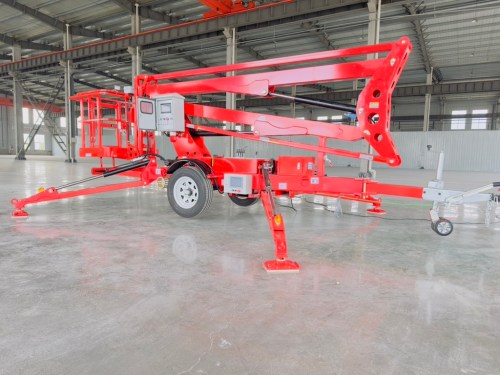
The ZMT TBL14 product page lists a maximum platform height of 14 m and an approximate maximum operating height of 16 m. It also lists an 8.5 m working radius and a 200 kg rated platform load for the published configuration.
Those figures describe different parts of the machine's capability:
- 14 m indicates the stated maximum platform elevation.
- Approximately 16 m indicates the stated operating or working height.
- 5 m describes horizontal reach under the manufacturer's specified conditions.
- 200 kg describes the platform load limit for the stated configuration.
A buyer should confirm the official working-envelope chart, dimensions and final specification in the quotation. The example shows why the model's "14 m" label is not the whole selection decision.
Why Maximum Height Alone Can Mislead
Imagine that a technician needs to service a light mounted 13 m above the ground.
If the lift can park directly below the light, vertical height may be the main requirement. But real jobs rarely provide a perfect setup point. The machine may need to stand:
- Outside a landscaped area
- Beyond a driveway edge
- Behind a wall or fence
- Away from overhead power lines
- Clear of pedestrian traffic
- Outside the collapse zone of unstable materials
- Far enough from a building to deploy the outriggers
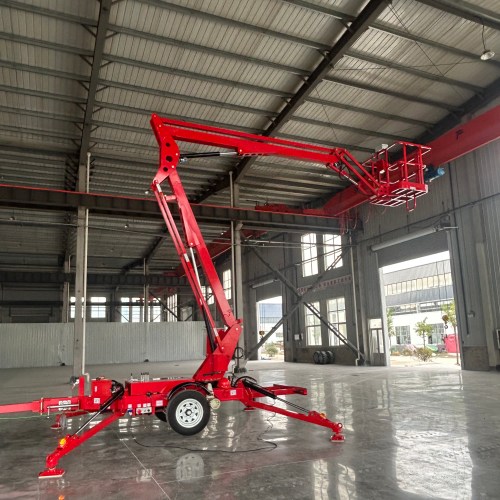
The platform must travel vertically and horizontally. The required point must fall inside the machine's approved work envelope while carrying the intended load.
A higher model is not automatically better. Larger machines may have:
- More transport weight
- A larger outrigger footprint
- Greater towing requirements
- Higher cost
- More difficult site access
- Different power and maintenance requirements
The correct machine is the smallest model that safely covers the real work envelope, load and site conditions with an appropriate selection margin—not simply the tallest model available.
Horizontal Outreach: The Missing Measurement
Horizontal outreach is the sideways distance the platform can reach from a stated reference point on the machine. It is crucial for work over obstacles.
Common applications that depend heavily on outreach include:
- Tree canopy access
- Roof and gutter maintenance
- Sign installation above storefronts
- Streetlight and CCTV service
- Façade inspection
- Work behind landscaping
- Access over machinery or production lines
- Event lighting and decorations
Maximum outreach may be available only at certain boom angles and platform loads. It should not be interpreted as a rectangular area in which the platform can move freely.
Ask the supplier for a working-envelope diagram. The chart should show the permitted vertical and horizontal positions of the platform. If different loads create different envelopes, request all applicable charts.
Do Not Confuse Outreach and Working Radius
Manufacturers may use terms such as horizontal outreach, working radius, horizontal reach or maximum outreach. The reference point may also differ.
When comparing quotations, ask:
- From which point is the distance measured?
- Is the figure measured to the platform edge, platform center or another point?
- Does the maximum apply at full platform capacity?
- Does the value change with optional equipment?
- Is the machine level and fully supported in the stated condition?
A difference of one meter can determine whether the platform reaches the task or stops short of it.
Up-and-Over Height and Articulation
Many towable boom lifts use an articulating boom. Instead of moving only in a straight line, the boom joints can lift the platform above an obstacle and then extend toward the work.
This is called up-and-over access.
For these jobs, record:
- Height of the obstacle
- Width or depth of the obstacle
- Height of the work point
- Horizontal distance from the setup position
- Clearance required for the boom structure
For example, reaching a façade behind a 3 m wall requires more than 3 m of platform height. The boom must clear the wall while staying within its work envelope, and the platform must approach the work without trapping the operator between the basket and the structure.
An articulating machine may outperform a taller straight-boom machine when the main challenge is obstacle clearance. Conversely, a telescopic boom may be more efficient when the job needs direct long-range outreach with few obstructions.
Platform Capacity Changes the Selection
Platform capacity includes more than the operator.
Add:
- All people in the platform
- Tools
- Materials
- Personal protective equipment
- Approved accessories
- Anything carried into the basket during the task
Never use the boom lift as a crane or suspend loads from the platform unless the exact machine has a manufacturer-approved attachment and procedure for that purpose.
Some boom lifts provide the same rated load throughout the envelope. Others have unrestricted and restricted capacity zones. A model may achieve its maximum outreach only at a reduced platform load.
When requesting a working-envelope chart, state the actual combined load. "One operator" is not a complete number if that operator carries heavy tools or installation materials.
Step 1: Measure the Work Point
Begin with the highest and farthest tasks, not the nominal building height.
Measure:
- Ground-to-work-point height
- Horizontal distance from the intended setup center
- Height and depth of obstacles
- Required access around corners
- Minimum safe distance from electrical hazards
- Space needed for the platform and operator
Use drawings, laser measurements, site photographs and a simple side-view sketch. Do not estimate a roof height from the number of building floors. Floor-to-floor dimensions, parapets, rooftop equipment and sloped ground can change the requirement.
If the project has many work points, record each point. The most difficult point may not be the highest. A lower point behind a deep obstacle can require more outreach than the roofline.
Step 2: Select a Realistic Setup Area
The boom lift cannot always stand at the most convenient geometric position.
Exclude locations with:
- Soft or recently filled ground
- Underground voids or services
- Covers, grates or basements
- Excessive slope
- Traffic conflict
- Inadequate outrigger clearance
- Proximity to holes or drop-offs
- Insufficient overhead clearance
- Unsafe proximity to energized lines
Mark the remaining setup area on the site sketch. Then calculate the required height and horizontal reach from that realistic position.
The setup area must also allow the towing vehicle and trailer to enter, turn and leave. A machine that physically fits after setup may still be impossible to deliver through a narrow gate or around a tight corner.
Step 3: Check the Outrigger Footprint
Towable boom lifts rely on outriggers or stabilizers to create their operating base.
The buyer needs:
- Maximum deployed width and length
- Approved alternative outrigger positions, if any
- Ground-bearing requirements
- Spreader-pad requirements
- Maximum allowable setup slope
- Chassis leveling range
- Clearance from edges, excavations and obstructions
Do not assume outriggers can be partially deployed to fit a restricted space. Partial, asymmetric or narrow setup is allowed only if the manufacturer designed and documented the exact configuration, including the resulting work envelope.
The ZMT TBL14 public specification lists a leg development area of 4.2 × 4.5 m for its published configuration. That footprint must be considered alongside the machine's transport dimensions and work envelope. Final requirements should be confirmed from the current technical documents.
Step 4: Check Access and Transport Dimensions
Before comparing working height, confirm that the machine can reach the jobsite.
Record:
- Narrowest gate or doorway
- Maximum available height
- Turning radius and corner geometry
- Surface capacity along the route
- Maximum permitted trailer weight
- Tow vehicle and hitch ratings
- Local towing width and registration rules
- Storage dimensions
Towable machines are valued for transport convenience, but a longer or heavier model may require a different towing vehicle, braking system or license category.
Ask for the machine's:
- Overall transport length, width and height
- Total weight
- Tongue or drawbar load, where applicable
- Tire and axle specification
- Hitch and electrical connection
- Braking and breakaway system
These values must refer to the exact ordered configuration, including engine, batteries and optional equipment.
Step 5: Match the Power Source to the Duty Cycle
Working height tells you where the platform can go. Power configuration affects whether it can complete the shift efficiently.
For indoor work, buyers often consider electric or battery power to reduce local exhaust emissions and noise. For outdoor projects with long shifts, combustion power may provide faster refueling. A dual-power configuration may serve mixed environments.
Confirm:
- Expected platform cycles per shift
- Available charging voltage
- Charging time
- Battery type and maintenance
- Fuel availability
- Ambient temperature
- Indoor ventilation
- Emergency lowering system
- Whether travel-assist or close-drive functions are fitted
Do not select a power configuration using only an engine or battery headline. Ask how the complete machine performs through the expected shift and environment.
Step 6: Review the Full Working Envelope
Overlay the site measurements on the manufacturer's envelope chart.
Check every critical work point against:
- Platform load
- Boom angle
- Horizontal outreach
- Up-and-over clearance
- Rotation limits
- Outrigger configuration
- Slope and leveling conditions
Allow a reasonable selection margin, but do not invent a universal percentage. The correct margin depends on measurement accuracy, site variability and manufacturer guidance.
If the work point sits directly on the boundary of the envelope, ask whether small site changes—such as a parked vehicle, landscaping barrier or restricted outrigger position—would make it unreachable.

Comparing 12 m, 14 m, 16 m and 18 m Models
Model numbers commonly indicate a nominal platform height or another height-related designation, but naming conventions differ. Never assume that "TBL16" means exactly the same measurement across all manufacturers.
Use a normalized comparison table:
|
Specification |
Model A |
Model B |
Model C |
Model D |
|
Maximum platform height |
|
|
|
|
|
Stated working height |
|
|
|
|
|
Maximum horizontal outreach |
|
|
|
|
|
Up-and-over height |
|
|
|
|
|
Rated platform capacity |
|
|
|
|
|
Platform dimensions |
|
|
|
|
|
Deployed outrigger footprint |
|
|
|
|
|
Transport dimensions |
|
|
|
|
|
Total transport weight |
|
|
|
|
|
Power options |
|
|
|
|
|
Rotation |
|
|
|
|
|
Towing/brake configuration |
|
|
|
|
Fill the table from official, current data sheets. Avoid mixing a base model with an optional configuration without labeling the difference.
When a 12 m or 14 m Class May Be Enough
Lower-height models may be appropriate for:
- Low-rise building maintenance
- Sign and lighting work
- Indoor halls with adequate access
- Tree care at moderate height
- Residential and light-commercial projects
They may offer easier towing, storage and setup, but only if the outreach reaches the work.
When a 16 m or 18 m Class May Be Better
Higher models may suit:
- Larger trees
- Multi-story façades
- Utility or lighting work at greater height
- Projects with wider obstacles
- Rental fleets serving a broader application range
The benefit must be balanced against transport weight, support footprint, cost and access.
Common Working-Height Selection Mistakes
Mistake 1: Using Building Height as the Only Measurement
The platform must reach the actual task from an approved setup point, not simply equal the building height.
Mistake 2: Confusing Platform Height and Working Height
Always request both numbers and their definitions.
Mistake 3: Ignoring Horizontal Outreach
Obstacles and setbacks often determine the machine more than vertical height.
Mistake 4: Forgetting the Outrigger Footprint
The machine may fit through the gate but have no safe space to deploy its supports.
Mistake 5: Assuming Maximum Outreach at Full Capacity
Check capacity throughout the work envelope.
Mistake 6: Comparing Model Names Instead of Data
Model naming is not standardized across suppliers.
Mistake 7: Ignoring Towing and Road Rules
A larger model may exceed the towing capability or regulatory limits of the intended vehicle.
Mistake 8: Buying Exactly to the Measured Limit
If the planned work point sits at the very edge of the chart, a small site difference may prevent access.
Information to Send a Manufacturer
For an accurate recommendation, send:
- Required platform height
- Height of the highest work point
- Required horizontal outreach
- Height and depth of obstacles
- Number of people and combined platform load
- Access width and height
- Available setup area
- Ground or floor conditions
- Indoor or outdoor use
- Preferred power source
- Towing vehicle details
- Destination country
- Expected quantity
- Photos or drawings of the jobsite
This information is far more useful than "Please quote a 16 m lift."

What is the typical difference between platform height and working height?
Manufacturers commonly add an assumed operator reach to platform height, but the exact convention can differ. Use the stated values in the official data sheet rather than applying a universal formula.
Is horizontal outreach measured at maximum platform height?
Not necessarily. Maximum height and maximum outreach often occur at different boom positions. The work-envelope chart shows the relationship.
Can the platform carry its full rated load at maximum outreach?
It depends on the model. Some machines maintain one capacity across the envelope; others use restricted and unrestricted zones. Confirm the exact load chart.
Should I choose one size larger than my measured requirement?
A practical margin can protect against measurement and site variation, but there is no universal "one size larger" rule. Larger machines affect towing, cost and setup. Review the complete envelope with the supplier.
Can I use a towable boom lift on a slope?
Only within the setup and leveling limits stated by the manufacturer. Outriggers are not permission to operate on any slope. Ground capacity and local conditions must also be assessed.
Does a larger working height always mean a larger horizontal reach?
No. Boom geometry differs. Compare the work envelope rather than assuming height and outreach increase at the same rate.
What is the most important document before buying?
Request the current technical data sheet and working-envelope chart for the exact configuration. For operation, the manufacturer's operation and safety manual is essential.
Select the Work Envelope Before the Model Number
The right towable boom lift working height is the height that reaches every required task from a safe, realistic setup position while carrying the intended platform load.
Start by measuring the work and obstacles. Identify a valid setup area. Confirm the outrigger footprint, access, towing requirements and power source. Then compare the official work envelope for each shortlisted model.
ZMT's towable boom lift range is intended for different working heights and project conditions. Send the team your required height, horizontal outreach, platform load, obstacles, access dimensions, ground conditions, towing vehicle and destination. A model recommendation can then be based on the actual job rather than a single brochure number.