8–16 Ton Spider Cranes for Steel Structure and Industrial Lifting
8–16 Ton Spider Cranes for Steel Structure and Industrial Lifting
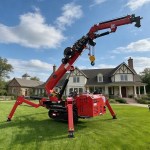
What Is a Large Spider Crane?
Large spider cranes extend the compact crawler-mounted crane concept into higher lifting-capacity classes. Models in the 8–16 ton range may be considered for steel erection, industrial equipment installation, structural components and project lifting where access or setup conditions make conventional cranes difficult to use.
A large spider crane is still governed by its load chart. Maximum rated capacity normally applies only under defined boom and radius conditions. Buyers must confirm every planned lifting case rather than selecting a crane only from the tonnage shown in its model name.
Compared with conventional mobile cranes, large spider cranes can often access confined work areas through narrower entrances before deploying their outriggers. This makes them a practical lifting solution for projects where space is limited but lifting capacity remains critical.
Typical Heavy Industrial Applications
Large spider cranes are widely used across heavy industrial projects where lifting capacity, restricted access, and precise positioning are equally important. Compared with conventional cranes, they combine high lifting performance with a compact crawler chassis, making them suitable for a wide range of industrial lifting applications.
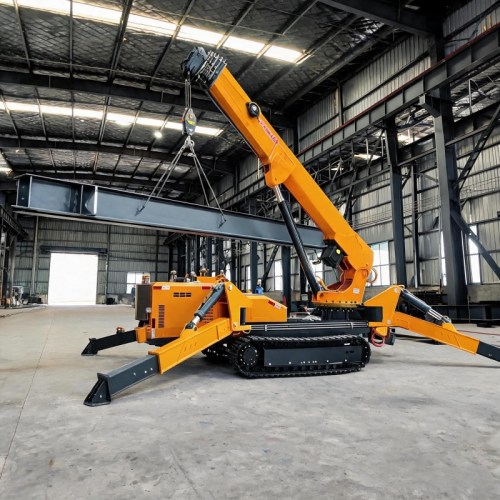
Steel Structure Installation
Large spider cranes are commonly used for steel erection projects, including lifting and positioning steel columns, structural beams, roof trusses, and prefabricated steel components. Their compact size allows contractors to work inside industrial buildings, warehouses, and urban construction sites where larger cranes may have limited access.
Typical lifting tasks include:
· Steel columns
· Steel beams
· Roof trusses
· Industrial warehouse structures
· Structural reinforcement projects
Industrial Machinery Installation
Manufacturing plants and industrial facilities often require heavy equipment to be installed within confined production areas. A large spider crane provides the lifting capacity needed for positioning machinery while remaining compact enough to maneuver through factory entrances and narrow service routes.
Typical applications include:
· CNC machine installation
· Generator positioning
· Transformer installation
· Production line equipment
· Heavy industrial machinery relocation
Precast Concrete and Infrastructure Projects
Heavy-duty spider cranes are also suitable for lifting selected precast concrete elements where site access is restricted. Contractors may use them for placing precast panels, bridge components, stair modules, and structural concrete sections that require precise positioning.
Glass and Façade Installation
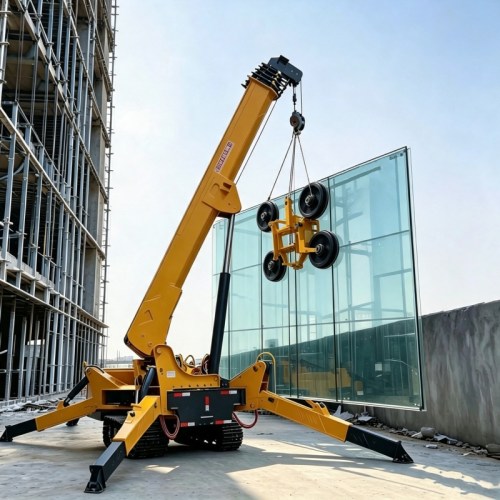
For commercial buildings and renovation projects, 8 ton spider cranes and larger models are frequently used to install oversized glass panels, curtain wall systems, and façade components. Their compact footprint allows them to work in courtyards, narrow streets, and restricted-access construction sites where conventional lifting equipment may not fit.
Typical applications include:
- Curtain wall installation
- Unitized façade panels
- Oversized glass replacement
· Architectural steel components
Plant Maintenance and Equipment Replacement
Industrial maintenance projects often involve replacing heavy equipment inside existing facilities without interrupting surrounding operations. Large spider cranes can be transported into factories, power plants, and processing facilities to support equipment replacement, maintenance shutdowns, and structural upgrades.
Common maintenance projects include:
· Heat exchanger replacement
· Pump and motor installation
· Boiler maintenance
· Industrial pipe modules
· Heavy maintenance lifting
Why These Applications Benefit from Large Spider Cranes
Across these industries, contractors choose heavy-duty spider cranes because they combine high lifting capacity with excellent mobility. Their crawler tracks help the crane travel across challenging jobsite conditions, while the outrigger system provides a stable operating base for lifting in confined spaces.
Why Choose an 8–16 Ton Spider Crane?
Selecting the right large spider crane depends on far more than its maximum rated lifting capacity. Every lifting project should be evaluated based on the actual suspended load, working radius, hook height, site access, and ground conditions.
The following table provides a general guide to common applications for different lifting-capacity classes.
|
Model |
Typical Applications |
Typical Users |
|
Steel structure installation, industrial machinery installation, curtain wall lifting |
Steel contractors, glazing contractors |
|
|
Heavy industrial projects, equipment installation, plant expansion |
EPC contractors, industrial contractors |
|
|
Heavy equipment positioning, manufacturing facilities, infrastructure projects |
Plant maintenance teams, equipment installers |
|
|
Large structural components, bridge construction, industrial fabrication |
Industrial construction contractors |
|
|
Heavy structural lifting, oversized equipment installation, complex engineering projects |
Engineering contractors, heavy lifting specialists |
While this comparison provides a useful starting point, the best spider crane is not necessarily the one with the highest lifting capacity.
Before selecting an 8 ton spider crane, 16 ton spider crane or any other heavy-duty spider crane, contractors should evaluate:
- Total suspended load, including the hook block, slings, spreader beam, and lifting accessories
- Required lifting radius and hook height
- Ground-bearing capacity and outrigger setup area
- Jobsite access width and transport restrictions
- Available working space and overhead clearance
- Project schedule and transportation requirements
A properly selected large spider crane improves lifting efficiency, enhances jobsite safety, and helps avoid unnecessary equipment costs. For every project, the final crane selection should always be confirmed using the manufacturer's official load chart rather than the crane's maximum rated capacity alone.
Key Factors Before Selecting a Heavy-Duty Spider Crane
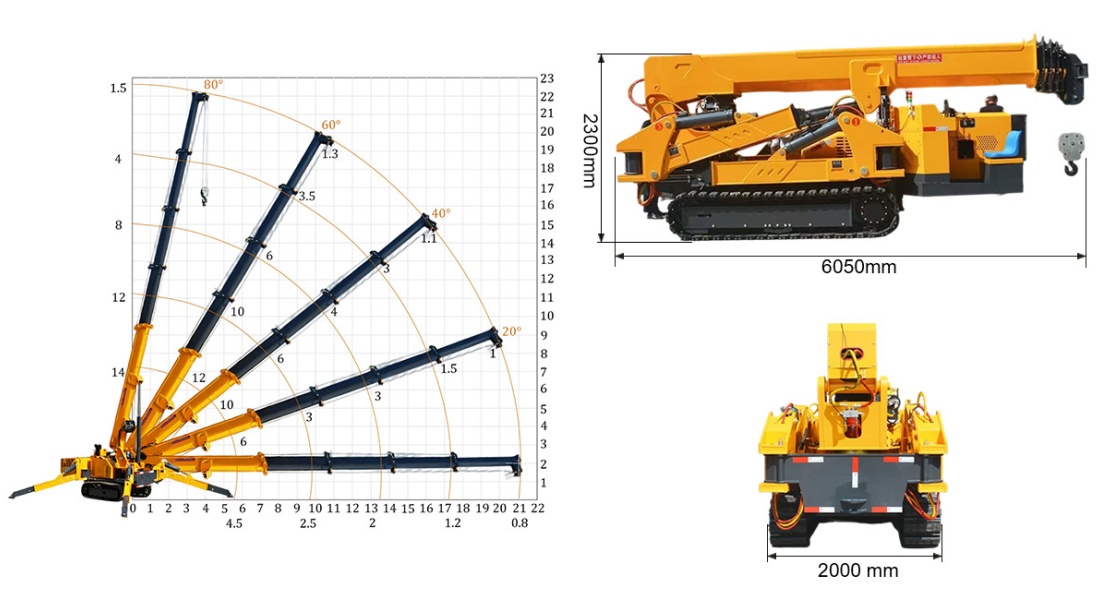
Choosing the right heavy-duty spider crane involves much more than selecting the highest lifting capacity. Before recommending a large spider crane, engineers evaluate several critical factors to ensure the crane can perform the lift safely and efficiently
Load Weight
The first step is determining the total suspended load, not just the weight of the equipment or structural component being lifted.
The total lifting weight should include:
- Hook block
- Slings and rigging
- Spreader beam
- Lifting attachments
- Any additional lifting accessories
Accurately calculating the complete suspended load helps ensure the selected large spider crane operates within its rated capacity.
Working Radius
A crane's lifting capacity is determined by its load chart, not simply by its model designation.
For example, a 16 ton spider crane can only achieve its maximum rated capacity under specific boom lengths and working radius conditions. As the lifting radius increases, the allowable lifting capacity decreases accordingly.
Always verify the required working radius before selecting a crane.
Hook Height and Boom Configuration
The required hook height directly affects boom configuration and lifting performance.
Projects with higher lifting points may require:
- Main boom extension
- Fly jib
- Additional lifting attachments
Confirming the required hook height early helps determine the most suitable crane configuration.
Ground Conditions
Proper ground preparation is essential before deploying outriggers.
Engineers typically assess whether the crane will operate on:
- Reinforced concrete
- Asphalt pavement
- Compacted gravel
- Steel plates or temporary mats
Ground-bearing capacity should always be verified to ensure safe crane setup and operation.
Site Access and Working Space
One of the biggest advantages of a large spider crane is its ability to operate in restricted-access environments. However, site access must still be evaluated before transportation and setup.
Typical considerations include:
- Factory gates
- Building entrances
- Service corridors
- Courtyards
- Indoor production areas
The crane's transport dimensions, outrigger footprint, and available setup space should all be confirmed before delivery.
Before requesting a recommendation, let our engineering team review your project specs. To recommend the most suitable heavy-duty compact crawler crane for your site conditions, our engineering team conducts a thorough Engineering Review to evaluate your project specs.
Engineering Review Checklist
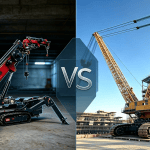
Large Spider Crane vs Conventional Crawler Crane
Choosing between a large spider crane and a conventional crawler crane depends on the project requirements, site conditions, and lifting objectives. While both machines are designed for heavy lifting, they excel in different working environments.
|
Feature |
Large Spider Crane |
Conventional Crawler Crane |
|
Best Jobsite |
Restricted-access construction sites, industrial plants, indoor projects |
Large open construction sites and infrastructure projects |
|
Site Access |
Can pass through narrow entrances and confined spaces |
Requires wide access roads and larger setup areas |
|
Indoor Operation |
Suitable for many indoor lifting applications (depending on ventilation and floor loading) |
Rarely suitable for indoor work |
|
Ground Pressure |
Generally lower due to compact size and crawler design |
Higher machine weight typically results in greater ground pressure |
|
Setup Space |
Compact outrigger footprint for confined work areas |
Requires significantly more operating space |
|
Mobility on Site |
Excellent maneuverability in restricted areas |
Better suited to open job sites |
|
Typical Applications |
Steel erection, industrial machinery installation, curtain wall installation, plant maintenance |
Heavy infrastructure, bridge construction, large-scale industrial projects |
A large spider crane is not simply a smaller version of a conventional crawler crane. Its primary advantage is the ability to combine substantial lifting capacity with compact dimensions, making it an effective solution for projects where access is limited but lifting performance remains critical.
For projects involving confined industrial facilities, urban construction, courtyards, or building interiors, a large spider crane often provides greater flexibility and easier deployment. However, for open heavy-lift projects with unrestricted access, extremely large loads, or long lifting radii, a conventional crawler crane or mobile crane may remain the more appropriate choice
Why Contractors Choose ZMT Large Spider Cranes
Heavy industrial lifting projects demand more than high lifting capacity. Contractors need equipment that delivers reliable performance, advanced safety, and engineering support throughout the project lifecycle. ZMT combines factory-direct manufacturing with practical lifting expertise to help customers complete complex industrial lifting projects safely and efficiently.
Engineered for Heavy Industrial Lifting
ZMT large spider cranes are designed for demanding applications such as steel erection, industrial machinery installation, precast concrete handling, and heavy structural lifting. Their compact crawler design allows contractors to access confined job sites while maintaining the lifting performance required for large-scale projects.
Advanced Safety Systems
Safety is essential when handling heavy loads. Our large spider cranes are equipped with advanced safety features, including an optional Load Moment Indicator (LMI), which provides real-time load monitoring and helps operators work within the crane's rated capacity. Combined with outrigger monitoring and multiple safety interlocks, these systems improve operational safety on complex jobsites.
Compact Design with Powerful Performance
Unlike conventional heavy lifting equipment, ZMT heavy-duty spider cranes combine high lifting capacity with a compact footprint. Their crawler chassis and hydraulic outriggers enable operation in factories, urban construction sites, plant maintenance projects, and other restricted-access environments where larger cranes cannot be deployed efficiently.
Multiple Power Options for Different Jobsite Requirements
Different lifting environments require different power solutions. ZMT offers diesel, Petrol, and electric large spider crane models to meet the needs of various industrial and construction applications.
- Diesel modelsprovide high torque and continuous power for demanding outdoor lifting, making them ideal for steel erection, infrastructure projects, and heavy industrial construction.
- Petrolmodels offer reliable performance with simplified maintenance, making them a practical choice for general construction, equipment installation, and projects where gasoline engines are preferred.
- Electric modelsdeliver low-noise, zero-emission operation for indoor lifting, manufacturing facilities, clean environments, and projects with strict environmental or emission requirements.
By offering multiple power options, ZMT helps contractors select the most suitable large spider crane for their working environment, operational requirements, and local regulations.
Factory Engineering Support
Every lifting project presents unique challenges. Before recommending a crane, our engineering team reviews lifting weight, working radius, hook height, site access, and ground conditions to recommend the most appropriate model, optional attachments, and lifting configuration for your application.
Global Delivery and Lifetime Support
ZMT supplies large spider cranes to contractors, rental companies, and industrial customers worldwide. We provide factory-direct technical assistance, spare parts support, and responsive after-sales service to help minimize downtime and keep projects on schedule.
Need Help Selecting the Right Large Spider Crane?
Our engineering team can help you choose the right model based on your lifting capacity, working radius, site access, and project requirements.
Frequently Asked Questions
Q:Can an 8 ton spider crane lift 8 tons at full reach?
No. The maximum rated lifting capacity is only achieved under specific boom length and working radius conditions. As the working radius increases, the crane's allowable lifting capacity decreases. Always refer to the manufacturer's official load chart before planning any li
Q:What industries use large spider cranes?
Large spider cranes are widely used in steel erection, industrial machinery installation, precast concrete handling, curtain wall installation, manufacturing facilities, plant maintenance, bridge maintenance, and other restricted-access heavy lifting applications.
Q:Can a 16 ton spider crane work indoors?
Yes, depending on the crane model and site conditions. Before operating indoors, contractors should verify floor loading capacity, access dimensions, ventilation requirements, and available setup space. Electric-powered models are generally preferred where low noise and zero-emission operation are required.
Q:How do I choose between an 8 ton and a 16 ton spider crane?
The correct crane should be selected based on the total suspended load, working radius, hook height, ground conditions, and available access—not simply the crane's maximum rated lifting capacity. An engineering review helps determine the most suitable model for each project.
Q:How is a large spider crane transported to the jobsite?
Most large spider cranes are transported by truck or trailer, depending on the model size and local transportation regulations. Before delivery, factors such as access roads, unloading space, and site dimensions should be confirmed to ensure safe transportation and setup.
Partner Direct with the Manufacturer
Selecting the right heavy-duty compact crawler crane requires balancing load performance, custom attachments, and jobsite access. As a direct manufacturer, ZMT delivers engineered lifting solutions, factory-direct pricing, and full technical backing for your fleet.
When your job site has slopes, rough terrain, or sensitive floors — a wheeled boom lift is the wrong tool. Full stop.